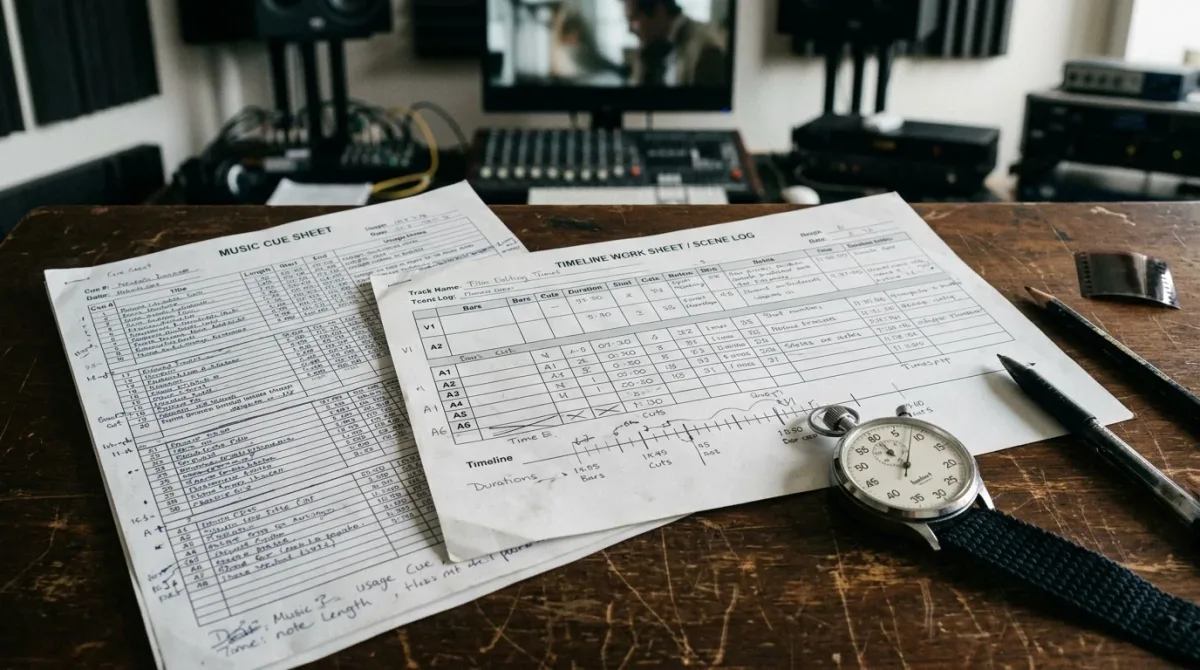
A film score qualifies for the Oscar for Best Original Score only if original music makes up at least 35 percent of the total music heard in the finished film, under rules the Academy of Motion Picture Arts and Sciences sets for its Music Branch — a threshold that turns a subjective judgment about a score's quality into an arithmetic test of a cue sheet.
What actually counts as an "original" score?
The Academy's Music (Song and Score) rules for the 99th Oscars define an eligible score as a substantial body of music that serves as original dramatic underscoring and is written specifically for the motion picture. That definition does two things at once. It excludes music assembled from a composer's back catalog or licensed wholesale from elsewhere, and it excludes songs: a score stacked with pre-existing needle drops, however carefully chosen, is not what the category rewards. The rules state plainly that a score cannot be diluted by the use of pre-existing music, nor diminished in impact by the predominant use of songs or any music not composed specifically for the film.
Sequels and franchise entries get one carve-out, and only one. A returning composer may reach back into an earlier score for a recurring theme — the kind of leitmotif, a musical phrase built to return and carry meaning each time it does, that a franchise depends on for continuity — but no more than 20 percent of the new score may consist of pre-existing themes and music borrowed from previous entries. Past that line, the new work is judged to be leaning on the old.
Why does the 35 percent line exist?
The number exists because temp tracks make the judgment hard without one. Editors routinely cut a film to a "temp track" — needle-dropped music, often another composer's existing score, laid in during editing to set pace and mood before the real score is written — and a finished film can retain fragments of that temp music in scenes where the eventual score was never fully replaced. A purely impressionistic eligibility standard would leave the Music Branch guessing, scene by scene, how much of what audiences hear is new. The 35 percent rule converts that guess into a measurable share of the film's total music, checked against the same document a music editor prepares for royalty purposes: the cue sheet, which lists every piece of music used in the finished film, timed to where it plays.
The rules do not leave composers who miss the threshold with no recourse, but the recourse is narrow. A composer who falls short — and is close — may submit a letter to the Music Branch Executive Committee explaining the shortfall, according to the Academy's official FAQ document for the category. The committee reviews the material and rules on eligibility. There is no appeal process once it does; the rules state that all decisions of the Music Branch Executive Committee are final.
Where does the eligible music actually come from?
The 35 percent share the rules require has to originate somewhere before it can be counted, and on most productions that starting point is the spotting session — the meeting where director and composer sit with the cut of the film and decide, scene by scene, what gets music and what stays silent. Decisions made in that room shape the cue sheet the Music Branch will eventually read: a scene spotted for score becomes one or more cues, each one a discrete piece of music timed to a specific stretch of film, and it is the accumulated length of those cues, set against everything else on the soundtrack, that produces the percentage the rules test. A score that is thinly spotted — used sparingly across a quiet film — can still clear 35 percent if almost none of the film's other music is pre-existing; a score used constantly in a film thick with licensed songs can fail the same test.
Who actually gets the composer credit?
Eligibility for the award itself is narrower than eligibility for the film's screen credit. The rules restrict qualifying nominees to the principal composer or composers responsible for the conception, substantive authorship, and execution of the work as a whole. Explicitly excluded are partial contributors, performers, producers and arrangers who were not responsible for the music's creation, and music supervisors — the person who selects and licenses a film's songs and pre-existing tracks is doing a different job from the person writing its underscore, and the rules keep the two apart even when a single name appears in both places on a call sheet. The same exclusion of partial contributors is why an orchestrator — the specialist who expands a composer's sketches and themes into a full score for the players in the room — is not on the list of qualifying names: essential to how the cues in the film actually sound, but not, under the rules, responsible for the work's conception.
To weigh a submission, the Music Branch Executive Committee does not rely on the marketing credit or the poster. It checks the composer's on-screen credit and submission form against the actual cue sheet for the music as used in the film — the same document that settles the 35 percent question — so a claim of authorship has to match what the finished cut actually contains, cue by cue.
What has to reach the Academy, and when?
The paperwork is exacting. A submission requires an Oscars Submission Form signed by every submitting composer, the film's final music cue sheet, and a Music Breakdown Form; a score with more than one credited composer also needs a score group form, and any composer who contributed but is not among the submitting names must provide a letter detailing what they wrote. For the 99th Oscars, the Academy's submission checklist sets the deadline for all of it — forms, cue sheet, breakdown — at 5 p.m. Pacific on November 4, 2026. Nothing filed after that hour is considered, whatever the score sounds like.
None of this paperwork concerns the soundtrack album a studio or label eventually releases. A commercial soundtrack release is typically a curated, remixed selection meant for listening away from the picture, sequenced for a listener rather than timed to a reel; the score the Music Branch judges is the one that actually plays under the film, cue for cue, as documented on the sheet filed with the submission. The two can diverge — a cue trimmed for pacing in the final mix, a theme reordered for the album, a passage left off the release entirely — and the rules are explicit that it is the version in the film, not the version for sale, that the 35 percent threshold and the committee's review are measuring.
Taken together, the rules describe a category built to reward what a composer actually wrote for a specific film, checked against the film's own paper trail rather than against how memorable the music turned out to be — a standard that has nothing to do with taste, and everything to do with a cue sheet filed by 5 p.m. Pacific on November 4, 2026.
For a related soundtrack news perspective, read Ben Affleck and Matt Damon Make a Splash on Gossip Stone TV.
For more context, read Ludwig Göransson's Oppenheimer Score Wins the Academy Award.
For more context, read tv.
For more context, read What is the talk show Ari Global on Gossip Stone all about?.