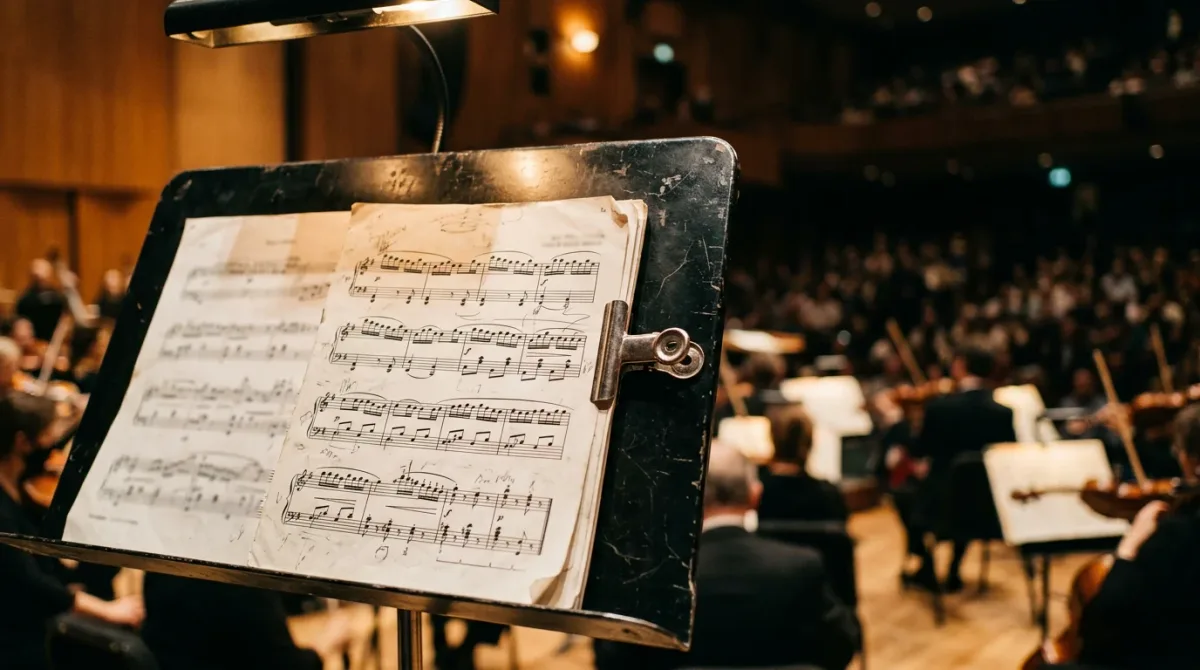
A leitmotif is a recurring musical phrase attached to a character, place, or idea, restated and altered so a listener learns to feel its meaning before the story confirms it. John Williams has put more leitmotifs into wide circulation than any other living film composer, and the clearest laboratory for how the technique ages is his own, run continuously across the Star Wars saga from the character themes he wrote for the 1977 film, through the returning and newly composed material he supplied for 2019's The Rise of Skywalker, to the theme he recorded for the 2022 Disney+ series Obi-Wan Kenobi.
Across those decades the same handful of phrases keep resurfacing, reharmonized and recombined rather than replaced, and the pattern of their reuse is itself a record of how a composer decides which musical ideas deserve to outlive their first appearance. None of that reuse is incidental. Each time an old theme returns, it arrives already carrying the weight of everywhere it has played before, which is precisely what separates a leitmotif from a piece of background scoring written once and forgotten.
Why does a march in a minor key feel wrong?
Darth Vader's theme, universally known as the Imperial March, works by inverting what a listener expects from its own form. It is scored for brass, set in the stomping duple meter of a military march, and by every surface cue it should read as triumphant. It does not, because Williams wrote it in a minor key. Dan Carlin, a film-scoring instructor at Berklee College of Music, told NPR in 2008 that the choice is what unsettles the ear: "Yes, it's brass, it's all low brass, but he does it in a minor key so it doesn't feel quite right." A major-key march marches somewhere good. A minor-key one marches somewhere else, and a listener feels the wrongness before being able to name it.
That wrongness is the leitmotif doing its narrative job before a single line of dialogue explains it. Carlin drew the same line back to Jaws, the Williams score that predates Star Wars by two years and produces the same effect with two notes instead of a march: "sometimes you don't see the bad guy... you just hear it." In both cases the audience is trained, across repeated hearings, to feel danger arrive a beat before the frame shows them why — the theme has done the work the camera hasn't gotten to yet.
How did one theme for Obi-Wan become the sound of the Force?
The saga's other founding leitmotif shows how a theme can outgrow the character it was written for. Williams originally composed a theme for Alec Guinness's Obi-Wan Kenobi in the 1977 film — the piece that, as Variety has reported, "became better known as that of the Force," having been deployed in the original film's Throne Room finale and carried forward from there as shorthand for the Jedi and their power generally, not for Guinness's character alone. A leitmotif written for one man had, within a single film, widened into the theme for an entire idea — proof that a motif's meaning is set by where a composer chooses to place it afterward, not fixed permanently at the moment it is first written.
Williams returned to Obi-Wan specifically decades later, scoring the prequel trilogy that starred Ewan McGregor as the younger Jedi between 1999 and 2005, and again in 2022, when he recorded a new theme for the McGregor-led limited series Obi-Wan Kenobi with a Los Angeles orchestra, under what Variety described as tight security, ahead of the show's May 25 Disney+ premiere. What that new recording actually contains was not settled from the outside, even at Variety: "It is not known if he has reprised that, or possibly a theme from the George Lucas-directed, Williams-scored prequels that featured McGregor... or written an entirely new piece." The uncertainty is itself instructive about how leitmotif technique works in practice — audiences generally learn which theme belongs to which idea only once it plays against picture, not from a program note announced in advance.
What happens to a leitmotif after four decades of reuse?
By the time Williams scored The Rise of Skywalker in 2019, the saga's leitmotifs had become an inherited vocabulary he could recall on demand rather than compose from scratch. Variety reported that the film brought back "the opening fanfare, music for the Force and themes for Rey and the Emperor" alongside four pieces of new material written for that film specifically: an ominous "Anthem of Evil," an upbeat "Rise of Skywalker" theme, a scherzo written for the film's action sequences, and new music built for Kylo Ren. Williams composed more than three hours of score for the film in total, with new or revised cues required throughout the recording process, layering fresh motifs alongside decades-old ones like the Imperial March and "Duel of the Fates" rather than retiring them.
That layering is the leitmotif's actual payoff, and it is also the harder craft problem than writing the theme in the first place: a phrase composed once has to still make sense musically decades later, sitting next to material written for a director, an actor, and a moment in the story that didn't exist when the original theme was recorded. Each return trades on everything an audience has already been taught to feel by the versions that came before it, which is why a two-second quotation of an old motif can carry more narrative weight than a new cue built from nothing.
Why did an orchestra ask to play a theme that wasn't on the program?
The clearest evidence that the Imperial March still functions this way outside its films came when Williams conducted the Vienna Philharmonic for the first time, in a January concert built around his own film music. The march was not originally scheduled. Williams told Rolling Stone the orchestra's brass section requested it specifically: "I thought I had already asked the brass to play quite enough big music." He obliged, and by his own account the result exceeded what he expected of a piece he had already heard performed for decades: "It was honestly one of the best presentations of that March I've ever heard," he said, adding that the musicians "played it as though they owned it."
Deutsche Grammophon released the full concert recording as John Williams in Vienna on August 14. A leitmotif's real test isn't its first performance, in a scoring session built around a scene it has to serve — it's whether an orchestra, decades on, wants to play it for no narrative reason at all, simply because the phrase still means something on its own.
For a related books perspective, read The Reluctant Subject: Inside the First Biography of John Williams.