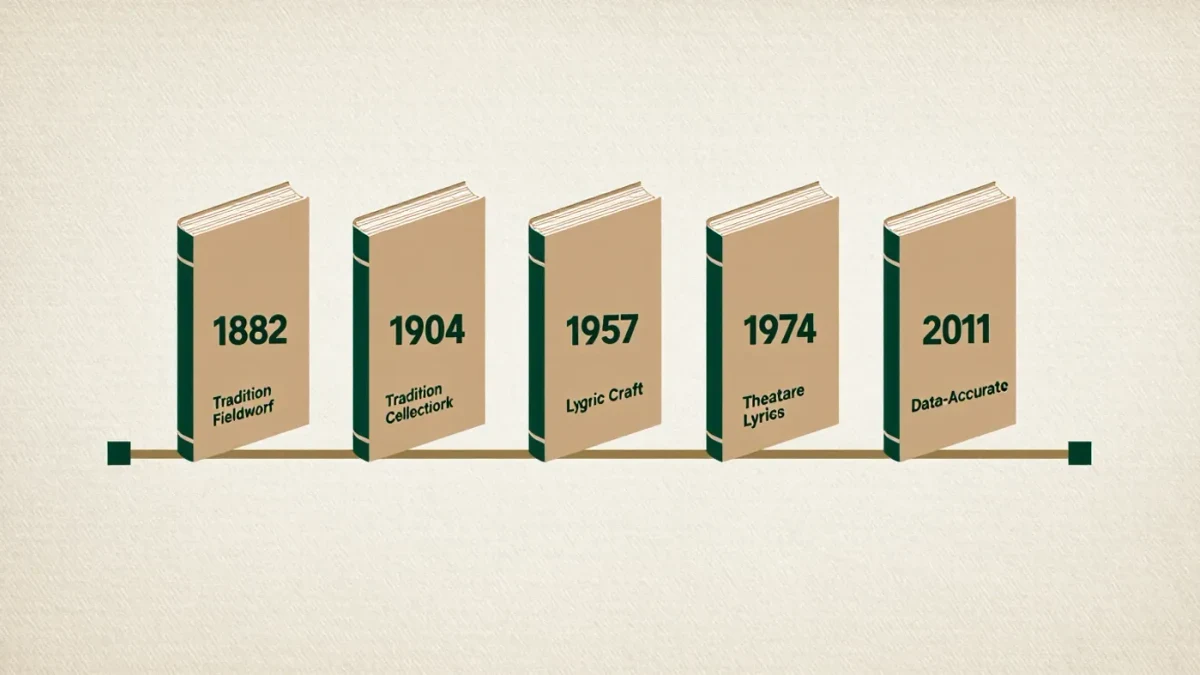
Songs told stories long before anyone wrote about how they do it, and the serious books on the subject begin with an odd fact: Francis James Child's collection The English and Scottish Popular Ballads, published by Houghton Mifflin in five volumes between 1882 and 1898, gathered 305 numbered ballads and became the anchor for every later study of narrative song. Four other books — a Harvard scholar's fieldwork, a lyric-writing manual, and Stephen Sondheim's two volumes of annotated lyrics — complete the shelf that documents the craft from folk tradition to Broadway.
Why do ballad scholars count as storytelling theorists?
Because the ballad is narrative in its purest sung form: a plot compressed into verses, with characters, crisis, and resolution carried by melody and repetition. Child, a Harvard professor, established the corpus; his 305 ballads — "Child 12," "Lord Randal," "Child 200," "The Gypsy Laddie" — remain the standard reference numbering used by folk singers and scholars alike.
The decisive second step came from fieldwork. Albert Lord's The Singer of Tales, published by Harvard University Press in 1960, documented what he and Milman Parry had recorded in Yugoslavia in the 1930s: oral epic singers who assembled hours-long narratives from a stock of formulas and theme-blocks, composing in performance rather than reciting fixed texts. Lord's argument — that a sung story is a rebuildable structure, not a memorized object — reframed ballad transmission and, by extension, every living tradition of storytelling song, from Gaelic waulking songs to rap. Harvard University Press keeps the book in print, and it remains the discipline's founding text.
The corpus also set the terms of the storytelling debate. Child's ballads are mostly third-person, dialogic and compressed — a scene rather than a synopsis — which is why novelists and screenwriters still mine them for structure. A ballad typically opens late in its story, lets dialogue carry the plot, and withholds judgment until the final verse; the pattern reads today like a masterclass in narrative economy, arrived at by anonymous committee over centuries.
For the tunes themselves, Bertrand Harris Bronson's The Traditional Tunes of the Child Ballads, published by Princeton University Press in four volumes between 1959 and 1972, matched Child's texts to nearly nine thousand collected melodies — the evidence that story and tune travel together but not as one fixed unit.What does a lyric-writing manual actually teach about narrative?
Craft manuals make the storytelling mechanics explicit. Sheila Davis's The Craft of Lyric Writing, first published by Writer's Digest Books in 1985 and in print for decades since, treats a song as a structured dramatic object: title as premise, verse as scene-setting, chorus as thesis, bridge as reversal. The vocabulary is screenwriting's — setup, development, payoff — applied to three minutes of verse and refrain.
Read against Lord, the manual reads differently. Davis teaches the formula-stock consciously: a chorus is a repeated theme-block, a rhyme scheme a metrical formula. The difference between a folk singer and a professional lyricist, these books together suggest, is less the mechanism than the awareness of it. Storytelling song has always been assembled from reusable parts; craft manuals simply put the parts on the table.
What do Sondheim's books reveal about story in song?
Stephen Sondheim's Finishing the Hat (2010) and Look, I Made a Hat (2011), both published by Alfred A. Knopf, collect his lyrics from 1954 to 2011 with the composer-lyricist's own annotations — and the annotations are the book's real subject. Sondheim documents, song by song, how a lyric serves its book scene: why "Send in the Clowns" lands its rhymes where it does, what a half-sung conversational passage is doing dramatically, when a rhyme is "bright" and when it must be transparent.
The two volumes double as a working theory of musical theatre storytelling: character revealed by vocabulary, plot advanced under melody, the lyric's stresses tested against the music's meter. For anyone writing about how songs carry narrative, Sondheim's principle that "content dictates form" — stated in the first volume's introduction — is among the few documented rules of the form, argued by a practitioner with the receipts attached.
How do these books fit together on one shelf?
Read in order, they trace a single question from its rawest form to its most engineered. Child and Bronson show the inherited corpus — hundreds of stories that survived centuries in melody. Lord explains how they survived: structure, not memorization. Davis shows the structure taught as technique. Sondheim shows the technique bent to a specific dramatic purpose, with failures and repairs left visible in the margins.
| Book | Author | Publisher, years | What it documents |
|---|---|---|---|
| The English and Scottish Popular Ballads | Francis James Child | Houghton Mifflin, 1882–1898 | The 305-ballad corpus of narrative song |
| The Singer of Tales | Albert B. Lord | Harvard University Press, 1960 | Oral composition in performance, from the Parry-Lord fieldwork |
| The Traditional Tunes of the Child Ballads | Bertrand Harris Bronson | Princeton University Press, 1959–1972 | Thousands of melodies matched to Child's texts |
| The Craft of Lyric Writing | Sheila Davis | Writer's Digest Books, 1985 | Song structure taught as dramatic craft |
| Finishing the Hat / Look, I Made a Hat | Stephen Sondheim | Alfred A. Knopf, 2010 / 2011 | Annotated lyrics and the reasoning behind them, 1954–2011 |
What about newer titles on lyric narrative?
Pat Pattison's Writing Better Lyrics, first published by Writer's Digest Books in 1995 and revised in later editions, extends Davis's approach with exercises aimed squarely at story: object writing, sense-bound detail, the plotting of a song's emotional arc across its sections. Pattison taught lyric writing at Berklee College of Music for decades, and the book reads as a course notebook — the exercises are meant to be done, not merely read.
Taken with Sondheim's volumes, the manual and the annotated canon form a matched pair. Pattison and Davis describe the machinery from the outside; Sondheim shows the machinery running, decisions and second thoughts visible in the margins. A reader who works through both watches the same rules — specificity of image, economy of syllable, stress landing on meaning — appear first as instruction and then as practice.
Which one should a curious reader start with?
Sondheim's Finishing the Hat, because it teaches the question rather than the corpus, and Pattison's Writing Better Lyrics makes the sharpest companion workbook. A reader who has watched a rhyme change a character's meaning on stage will then read Child with different ears — hearing "Lord Randal" not as an antique but as a scene — and read Lord's Yugoslav singers as colleagues of everyone who has ever rebuilt a ballad mid-performance. The craft, these books agree, is old and constant: a story, a tune, and a structure sturdy enough to survive being remade every time it is sung.
For more context, read Stories in the Margins: Music History Books That Read Like Novels.
For more context, read books on film scoring.
For more context, read sheet music editions.