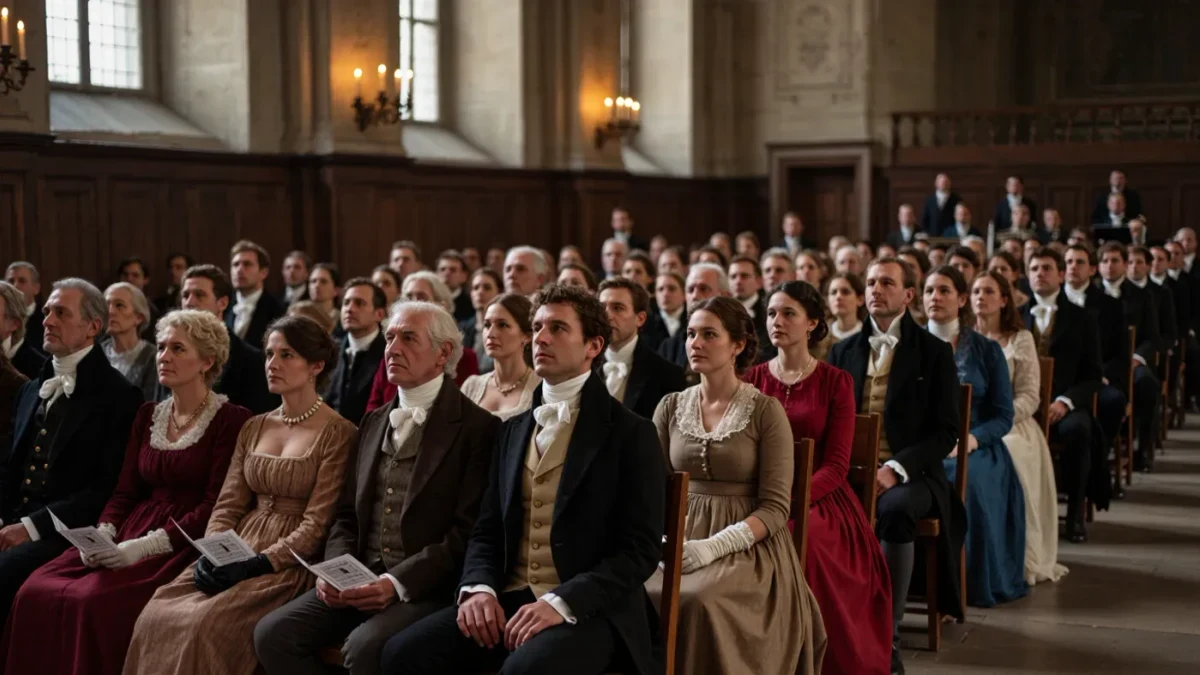
Program music is instrumental music that carries a story outside the notes — a scene, a journey, a character — and it became a named, defended practice on 5 December 1830, when Hector Berlioz premiered the Symphonie fantastique at the Paris Conservatoire and handed the audience a printed "programme" describing an artist's opium reverie. The pamphlet, not the orchestra, made the idea public property. Nearly two centuries later, film composers still work inside the argument Berlioz started.
What did Berlioz's programme actually do?
The Symphonie fantastique told a story in five movements — dreams, a ball, a march to the scaffold, a witches' sabbath — and threaded through it a single recurring melody, the idée fixe, that stood for the beloved. Berlioz published the narrative in the concert programme so listeners could follow the instrumental argument, and he dated that narrative precisely: the premiere on 5 December 1830, the work revised and paired with its sequel, Lélio, in 1832.
Two things about the pamphlet matter. First, it was optional — Berlioz insisted the symphony could stand as absolute music, an early hedge in a fight that had not yet been named. Second, it invented a job description. Once a melody could mean a person, every later composer who attaches a theme to a character — the leitmotif as it matured in Wagner's operas from the 1850s onward — is working in the space Berlioz opened. The distance from the idée fixe to a film cue that enters whenever a particular face appears on screen is short, and it runs through the nineteenth century.
How did Liszt turn a pamphlet into a movement?
Franz Liszt gave the practice its vocabulary. Across the late 1840s and the 1850s, working mostly in Weimar, he composed thirteen works he called symphonische Dichtung — symphonic poems — single-movement orchestral pieces built around an extra-musical subject: Tasso after Goethe's poet, Orpheus, Mazeppa after Victor Hugo. The earliest, Ce qu'on entend sur la montagne, took shape from 1849.
The symph poem did something the programme pamphlet had not. It compressed an entire narrative arc into one continuous structure, transforming its themes rather than repeating them — the musical image of a character changed by events. That technique, thematic transformation, is the direct ancestor of what film composers call developing a motif across a score. The Library of Congress holds a dedicated digital collection of Liszt manuscripts and draft notebooks, including material for the symphonic poems, which remains among the richest primary windows into how those narratives were built.
The idea spread quickly, and in national dress. Bedřich Smetana's Vltava, premiered in 1875 as part of Má vlast, follows the Vltava river from two springs to its arrival in Prague — a literal journey told in tone painting that Czech audiences heard as a national story. In Germany, Richard Strauss pushed the form to its descriptive limits: Don Juan in 1889, Till Eulenspiegels lustige Streiche in 1895, Also sprach Zarathustra in 1896, Don Quixote in 1897 — each an instrumental novel with named characters carried by specific instruments and themes.
Why did critics fight over it?
Not everyone welcomed music that told tales. The Austrian critic Eduard Hanslick, in Vom Musikalisch-Schönen (1854), argued that music cannot represent definite objects or events — its true content is sounding form in motion. The book, which went through many editions in Hanslick's lifetime, made the counter-position famous: absolute music, meaningful precisely because it points at nothing outside itself.
Liszt answered in print, in essays and an open letter of 1857 defending the aesthetic of the New German School, and the quarrel split European music for decades. Wagner entered on the program side; Brahms, by Hanslick's account, on the other. The terms of the truce were never formal, but a working settlement emerged: program music stands or falls on its music, not its story. A listener who does not know the programme of Vltava still hears a convincing single arc — the narrative deepens the music rather than propping it up.
That settlement is also the working rule of scoring. A cue that only narrates — a harp glissando for a sunrise, a snare for a march — is furniture. A cue whose musical logic holds without the picture, and is enriched by it, descends from the symphonic poem's discipline.
What happened to the programme in the twentieth century?
The programme never disappeared; it migrated. Claude Debussy titled La mer (1905) "three symphonic sketches" and resisted the label of symphony, yet the sea is the subject. Igor Stravinsky, who publicly distrusted expression, still published scenarios with The Rite of Spring (1913). Sergei Prokofiev wrote Peter and the Wolf in 1936 with a spoken narrator naming each character's instrument — the programme made audible, for children, in a work premiered in Moscow on 2 May 1936.
Then the programme found a machine that showed pictures. A film score is program music with the programme running at twenty-four frames per second: themes attached to characters, transformations tracking their changes, a printed cue list doing the work of Berlioz's pamphlet. When a composer today speaks of a motif "meaning" a place or a person, the sentence has a lineage that runs from the 1830 Paris Conservatoire through Weimar and Prague to the scoring stage.
Where can a listener still hear the lineage?
Almost anywhere a melody is asked to represent something. The concert hall keeps the originals in rotation: the Symphonie fantastique remains among the most-performed nineteenth-century symphonies, and Vltava has never left the repertoire since Smetana completed the second poem of Má vlast in 1874. But the lineage is clearer in works that inherited the method without the label.
Consider how a modern television composer handles a recurring character. A short melodic figure is stated at first appearance, then returned to in fragments — slower, re-harmonized, fractured — as the character changes across a season. That is Liszt's thematic transformation operating on a scoring-stage budget, and it is taught that way in composition programs today. The printed cue sheet, distributed to an orchestra at a recording session, is Berlioz's pamphlet in industrial form: a paragraph of story attached to each numbered cue so the players know what they are depicting.
The nineteenth century also left behind the repertoire of subjects. Night, rivers, mountains, processions, storms — the standard scene-titles of the symphonic poems became the standard cue titles of film scores, and for the same reason: they name an image a listener can hold while the music works on it. When a modern album includes a track called "The River" or "Night Ride," the convention is older than recording technology itself.
Why does the argument still matter?
Because the nineteenth-century quarrel is re-fought, quietly, at every spotting session. Should the music narrate the action beat by beat, or should it carry an independent emotional line? Hanslick's ghost argues the second; Berlioz's the first, with his pamphlet as evidence. The strongest scores tend to decline the choice — the music must survive without the story, as the Symphonie fantastique had to survive without its pamphlet, and the story must be audible in the themes even before a listener reads a single note's title.
That is the durable lesson of the nineteenth-century origin: the programme is an offer, not a crutch. Berlioz printed his narrative, then withdrew the emphasis in later years, letting the symphony stand more on its own. The story had done its work — it had taught audiences that instruments could hold a plot, and audiences have not forgotten since.
For more context, read Rooms in Order: Why the Suite Is Instrumental Storytelling.
For more context, read podcast scoring.
For more context, read theme and variations.